Developments in artificial intelligence for mediators, coaches and counsellors
What opportunities are offered by artificial intelligence to support yourself and your employees as a self-employed person?
II AI as contact partner
1. introduction:
Artificial intelligence is also a unique area of reflection for us self-employed people - for us as mediators, coaches and consultants
For the self-employed, especially for mediators, coaches and consultants, artificial intelligence is first and foremost an area for reflection.
They are neither fact machines nor decision-making bodies from the outset. Admittedly, they can be used in the same way that any instrument can be misused. But artificial intelligences are not tools in the traditional sense. They are not simply a hammer or a musical instrument.
Artificial intelligences are man-made systems that have not only been developed objectively, but have also been and continue to be orientated in their mode of operation. This orientation does not end with the handover to the user. It continues through providers, platforms, business models and infrastructural embedding. Artificial intelligence rarely operates exclusively locally. As a rule, they are connected to third parties via networks, cloud services and interfaces.
This is precisely why they develop their special quality as surfaces for reflection and interaction. They confront us as a counterpart, as a screen on which thinking, exploring, deciding and acting are reflected. They comment, structure, irritate, enrich and thus also control processes of professional practice.
Interim remark:
This article is not aimed at IT specialists or AI enthusiasts. It is aimed at potential users who reflect on their professional activities and at least do not rule out the possibility that AI technology could support them in their work.
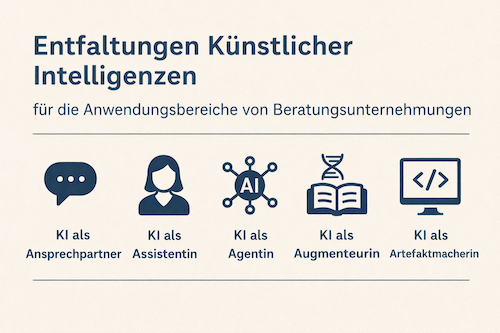
This opens up considerable potential for the self-employed in general, but especially for consultants, coaches and mediators who work with life, conflict and decision-making issues. Artificial intelligence can be utilised in a variety of roles:
-
as contact personas a dialogue partner for technical, linguistic or conceptual questions, also as a foreign language assistant;
-
as assistantwhich takes over recurring tasks, collects, organises and consolidates information and thus reduces workload or increases productivity;
-
as agentwhich independently pursues goals, connects systems, initiates processes and prepares or implements decisions;
-
as augmenteer (a deliberately artificial word), which integrates external knowledge spaces via RAG systems and updates them in a context-sensitive manner;
-
as artefact makerwhich develops software applications and makes them usable as AI-based tools.
In all these functions, artificial intelligence is becoming an ever-available companion: friendly, tireless and comparatively inexpensive. They open up opportunities for professionalisation and business development, but also bring with them new risks and dependencies.
In other words: The use of AI requires a new cultural technique. It forces us to enter into a relationship with a non-living being that behaves "like a living being" in the interaction. Artificial intelligences affect, motivate and structure attention. They change routines, forms of communication and power relations and therefore also the field of counselling, coaching and mediation.
For consultants and the self-employed, artificial intelligence is therefore less an optional additional tool than an imposition on existing routines. Their very existence forces them to position themselves. This article assumes that AI as a cultural technology of the 21st century requires a form of individual and social literacy.
Another fundamental aspect: AI applications must be designed, configured and implemented. However, they are not necessarily used by the same people. Consultants can use AI for themselves or make it available to their clients. Design and utilisation fall apart.
II KI as contact person
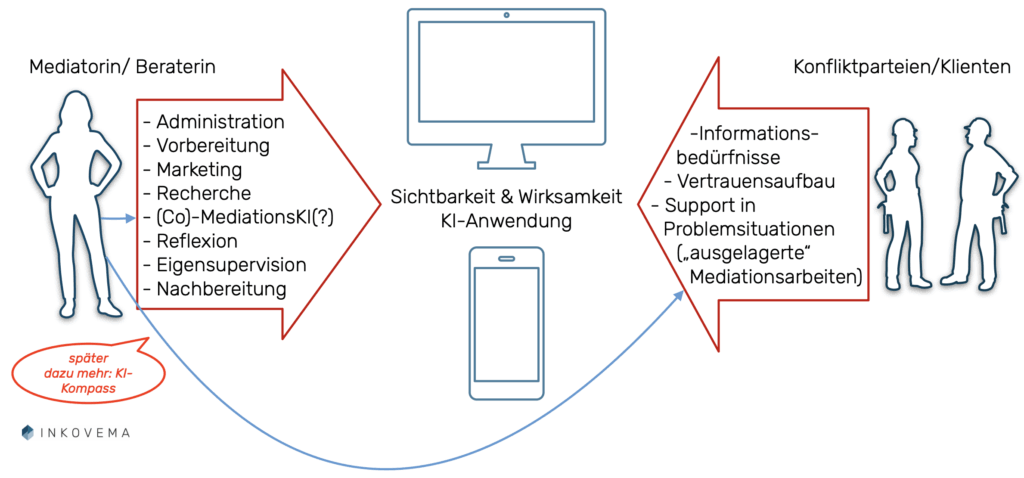
When self-employed people, consultants or mediators use AI as a point of contact, it usually starts with a question, a topic or a task. The AI acts as an aid to thought, a space for reflection and a dialogue partner. It helps to illuminate and analyse initial questions from different perspectives.
In this role, AI becomes a sparring partner. It not only provides information, but also asks questions that are explicitly requested by the user. In this way, it helps to deepen considerations, check assumptions and incorporate alternative interpretations. Professional, everyday and social perspectives are brought into the dialogue.
For consultants, this means Thoughts can be structured, hypotheses sharpened and new insights gained. AI becomes a flexible, always available counterpart that expands your own professional perspective without becoming exhausted or annoyed.
The AI does not lose this function even if it is used in more advanced roles or configured in a technically more complex way. For many users, ChatGPT was their first contact with AI in precisely this role. However, it is only the first stage.
II AI as an assistant
As an assistant, artificial intelligence takes on recurring tasks, collects and structures information, summarises texts and thus reduces workload or increases efficiency. It responds when spoken to, but does not just act mechanically. The focus remains on a language model that interprets and contextualises flexibly.
For an AI to fulfil this role effectively, it needs clear guidance: a system prompt. This defines the role, tasks, goals and limits. The start and end of an interaction can also be defined.
This turns a random dialogue partner into a targeted assistant. She accompanies complex topics, thinks along, structures and drafts resilient work statuses. With every piece of feedback, a finer balance is created. Trust grows. A tool becomes a reliable partner in everyday working life.
This assistance does not have to be limited to internal use. It can also be used in contact with customers and interested parties. For example, as the first point of contact on a website that receives enquiries in a structured manner, provides information and prepares discussions.
II AI as agent
We speak of an AI agent system when an artificial intelligence independently pursues a goal. It does not wait for specific instructions, but begins to act independently. To do this, it uses different tools, selects them and combines them.
A language model is usually at the centre, supplemented by planning and decision-making logic. The result is an AI that not only reacts, but also acts.
Examples:
- An AI-based chatbot on a company website not only answers questions, but also actively pursues the goal of concluding a contract. It enquires about interests, offers suitable information and, ideally, can prepare a legally binding contract. At this point, the operator of the AI becomes legally bound.
- Internally, a calendar entry (e.g. typed or spoken) could trigger both hotel and train ticket bookings, which would require a large number of steps, including legally binding ones.
II AI as augmenter: the RAG system
Retrieval augmented generation systems combine language models with external knowledge sources, e.g. the internet. The AI does not generate texts solely from its training knowledge, but also accesses current, maintained databases, e.g. its own databases, which are not (or do not have to be) online. In this way, hallucinations can in principle also be reduced, or at least up-to-dateness and accuracy can be integrated into the AI's knowledge base.
For independent consultants, this means AI works on a reliable, self-directed knowledge base that can be continuously updated. Answers are formulated in a more context-sensitive and connectable way and adapted to specific practical requirements.
II AI as an "artefact maker"
With systems such as Claude from Anthropic, a further level is reached and an important function is integrated that appeals to non-programmers in particular. AI can not only communicate, but also develop software applications on the basis of "programming language-free speech/commands". The AI acts as a software developer that listens to commands/prompts that do not have to originate from the programming language.
This allows consultants to develop customised applications without having to be able to program them themselves. These applications can, of course, also be AI-based.
Example:
An AI-supported quiz app or counselling simulation that generates questions and counselling cases, evaluates answers and counselling sessions and provides feedback. Integrated into the company's own website, an independent artefact is created that goes far beyond a classic chat and in this way promotes training and further education.



Leave A Comment