BATNA, RePo, ZOPA and other reference points in negotiations
Negotiation preparations and negotiation structures
Introduction
The basic negotiation structures, in particular the reference points, are important and enable structured preparation for negotiations.
Although less experienced negotiators in particular often admit to a lack of good preparation, this is mainly due to the fact that most people are unclear about how they can actually prepare for a negotiation. It is not uncommon for preparation to be limited to the question of where one's own pain threshold lies. But that is a start.
The following article is intended to provide further, fundamental suggestions on what needs to be considered before negotiations begin! The following reference points are named and categorised.
- BATNA or Best Alternative to a Negotiated Agreement
- ZOPA (Zone of possible Agreement)
- RePo (Reservation Point, bottom line, walk-away, pain threshold)
- Opening offers
- Negotiation target (target point)
Case studies
Example 1: Equalisation payment
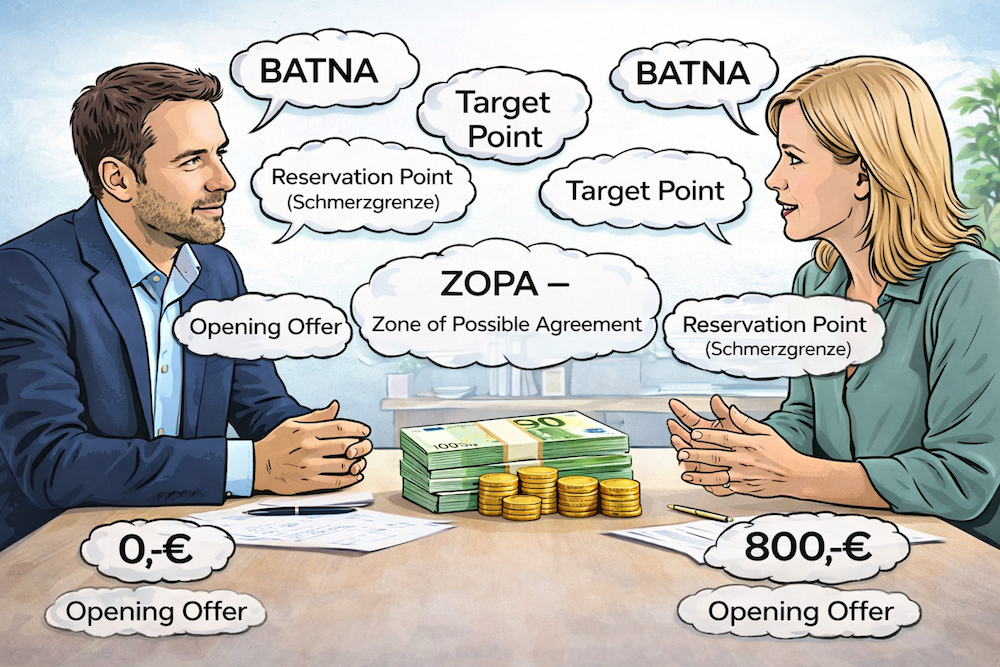
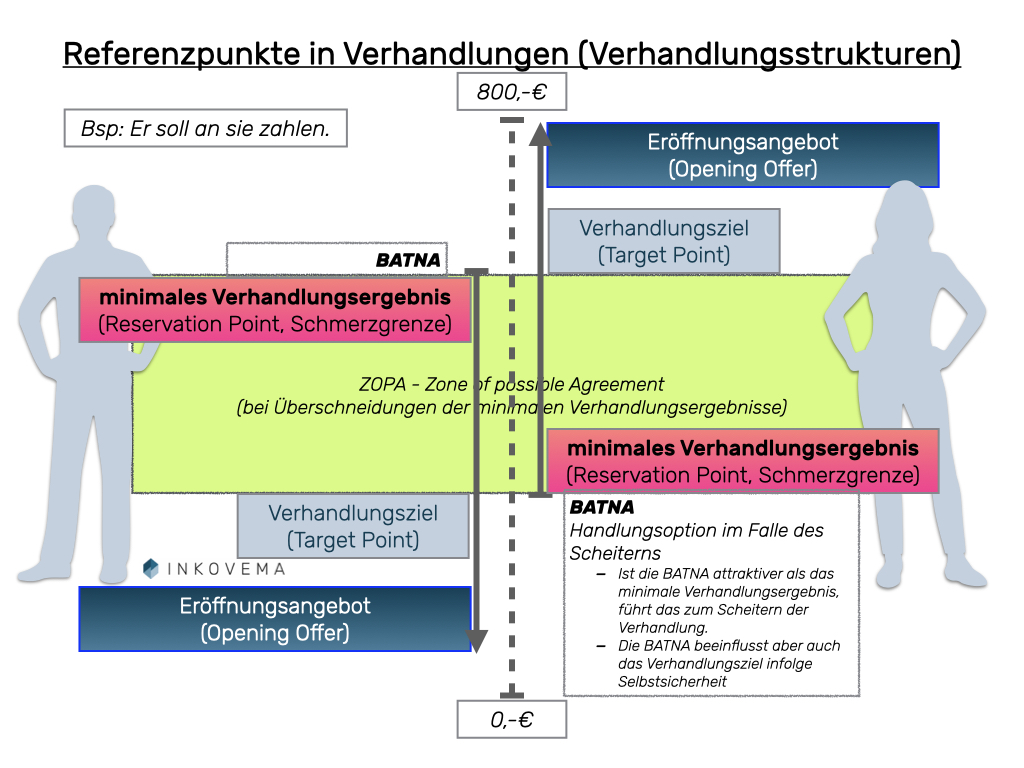
An equalisation amount is at issue between two people. There is a claim for €800 and a refusal to make any payment, i.e. €0. The fact that an agreement is to be reached is important for both parties. The reason for the equalisation payment can be the use value of items (e.g. car, flat, house, etc.) or maintenance payments because the joint child lives with one of the two negotiating partners.
Example 2: Salary negotiation
This example deals with the determination of the annual salary for the new employment of an employee (employee) by an employer (employer). The salary expectations could initially be as follows: The employee would like 110,000 euros. The client would like 80,000 euros. Depending on the assignment, it would first be important to clarify what these expectations are: Target points, pain thresholds, opening offers (already communicated?) or whatever?
BATNA = best alternative to a negotiated agreement
(agreement alternative)
A central and often early reference point for negotiations is the BATNA, the Best Alternative to a Negotiated Agreement, of each negotiating party. It can only be emphasised that this BATNA is consciously sought and constantly improved by each negotiating party. The BATNA should not be seen as monolithic, fixed and unchanging, but rather as dynamic and always related to the specific negotiation itself.
It describes the best alternative available to a negotiating partyif no agreement is reached in the actual negotiations. The BATNA answers the question of what will be done if no agreement is reached in the underlying negotiation. This question should before the start of negotiations (can) be answered. A strong BATNA gives the associated party negotiating power. It provides orientation about the existing market, the negotiating environment and the specific framework conditions. It provides orientation, How dependent one party is not in favour of an agreement and how much room for manoeuvre actually exists. The stronger or more attractive the BATNA is for the "owning" negotiating party, the more relaxed the latter can negotiate. Conversely, a weak BATNA increases the pressure to agree to an agreement on less attractive but still better terms than the weak BATNA. Knowledge of one's own BATNA is therefore part of the basic preparation for every negotiation. And sometimes it also seems worthwhile to think about the possible settlement alternatives of the other side - and at best to have knowledge of their BATNA.
But Caution: Improving the BATNA is the The best way to prepare for negotiations, It is the strongest isolated position of negotiating power available, but it also has an Achilles heel (Voss). Firstly, Voss points out in passing, but quite rightly, that the BATNA the best second option because, of course, the negotiation should be better with the negotiation objective pursued! So if you would prefer to resign anyway, you should not negotiate for a pay rise first, but choose the better option straight away. However, Voss' objection that the development of the BATNA can also lead to (certain) people preferring to negotiate themselves down in advance in this way seems much more important to me. Due to the complexity of negotiations, people quickly focus on one point that keeps the whole matter manageable - and that is the BATNA. The BATNA thus becomes the focal point, the target price, and prevents the negotiator from striving for far more ambitious goals. In fact, any better result above the BATNA is a complete success. This low target is then underpinned with good, moral reasons that the other side should also have something and that the whole theatre here is a win-win event. In fact, it is a Wimp-win mentalitywho leads here. This has the advantage that even mediocre results can be communicated as successes.
Case studies:
- Whether and to what extent the compensation payments could or could not be achieved by means other than negotiation (e.g. through the courts) has a considerable influence on the BATNA of both sides. It is also possible that compensation other than financial compensation could be considered.
- Before entering into recruitment negotiations, it is worth taking a concrete look at the applicant and job market. It is easier to negotiate with an applicant who is asking for €100,000 (entry-level offer or pain threshold?) if you have another equally qualified applicant who is asking for €90,000, for example. This also applies if this applicant is asking for €105,000. It is important that the "other" price is not included in the negotiations. The better price is not the decisive factor, but the knowledge of the market, the criteria, the valuations, the situation as a whole. Conversely, this also applies to the applicant: if this person knows specifically what they will do if they don't get the job they are aiming for and also finds it attractive, they have a strong BATNA. These can be alternative plans for work, as well as other job offers. Studies show that applicants who have other job offers usually negotiate a higher salary (see Gallo, HBR, July 5, 2016).
- Incidentally, the above does not only apply tofor the labour market, but also for other markets. Anyone looking to buy a heat pump, a swimming pool or even a customised racing bike would do well to do their research. For example Invitations to tender to potential sellers/manufacturers/retailers. Your offers are important sources of information and Generators for strong BATNAs. Ultimately, the negotiation should not be based on mutual prices ("But the other one does it cheaper than you!"), but the offers, descriptions, promises, advantages, etc. offer criteria that can be used in the negotiation - and then the price can be negotiated with the most suitable supplier, because his offer was also an initial offer and not his last word!
RePo - Reservation Point
(retraction point, pain threshold, walk-away line, bottom line)
The Reservation Point refers to the point at which a negotiating party is prepared to break off negotiations. The reservation point is often also referred to as walk-away-line labelled or referred to as bottom-line. It marks the personal Pain thresholdbeyond which an agreement would be worse than no agreement.
Sometimes the Reservation Point confused with BATNAespecially if improvements to your own BATNA have not been actively and strategically pursued. Then the reservation point "appears" to be identical to the BATNA. But this is ultimately a misunderstanding of the BATNA concept and is tragic in any case.
It must be admitted, however, that the Reservation Point, like the BATNA, is not to be thought of in absolute terms, but rather dynamic negotiation and therefore needs to be kept in view at all times.
Case studies:
- In the case of compensation payments, the pain thresholds can of course be assumed to be between €0 and €800, although part of the negotiation preparation and negotiation strategy should be to find out where these limits actually lie. After all, if €800 is claimed as a starting point, the pain threshold can generally be assumed to be lower, but how much lower? Likewise for the other side, if the first answer was that nothing would be paid at all! This is not the end of the line, but the start of a negotiation.
- But even in the case of the labour market, it is important to at least know the pain thresholds, even if they are not the target point! Who wants to work permanently at the pain point?
ZOPA - zone of possible agreement
(negotiation room, solution room, negotiation zone)
Another central point of reference in negotiation theory is the ZOPA (Zone of Possible Agreement).
ZOPA refers to the area in which an agreement between the negotiating parties appears possible. In this space, an agreement would in principle correspond to the interests of both sides. This space only exists if the respective pain thresholds (reservation points, more on this in a moment) overlap. Otherwise, this ZOPA space does not exist.
It is therefore important for negotiating parties to know whether this solution zone even exists - right at the start of negotiations(!). If it does not exist, negotiations appear nonsensical and a waste of resources, at least in retrospect. However, the negotiating parties themselves cannot simply inform each other of their pain thresholds. This would make further negotiations impossible. This is why you often have to rely on assumptions here, i.e. negotiating parties should think about whether this ZOPA space exists or not.
Case studies:
- If the side claiming payment considers its pain threshold to be €600 (and otherwise goes to court!) and the side claiming payment considers its pain threshold to be €300, then there is no ZOPA. However, if the side claiming payment is also satisfied with €150, even if this is far less money than the €800, and if the side claiming payment is also prepared to pay €700, albeit with stomach ache, then there is a wide zone of possible solutions, namely between €150 and €700.
- If the job advertisement states a salary of €90,000, it is questionable for the applicant whether this figure represents a genuine starting offer that can be increased - or whether it already represents the pain threshold. The situation is the same for the employer if the applicant (casually) believes that a six-figure salary seems appropriate.
Target Point
(negotiation target)
The Target Point describes the concrete goalthat a negotiating party would like to achieve with the negotiation. It is usually much more favourable or better than the party's own reservation point and also serves as a Internal orientation for strategy and argumentation. Sometimes it is announced to third parties or the public and puts the negotiations under pressure. For example, when expectations are publicly expressed in advance to the press or to the company's own clientele (shareholders or employees) in collective bargaining, i.e. in such a way that the negotiating partner registers these goals/expectations.
The target point is not a minimum value, but a desired value. In principle, it helps to categorise offers, consciously manage concessions and realistically use your own negotiating leeway. Without a clear target point, negotiations quickly lose direction.
Opening Offer
(opening offer)
The Opening Offer is the first offer that is made or at least expected at the start of a negotiation. This can take the form of a request for proposals, for example. However, such requests for proposals should not be used as a basis for negotiation, but for your own BATNA optimisation. In addition, the Opening offer one Anchorwhich the further course of the negotiation is often based on. Opening offers are rarely meant to be realistic, but serve to structure the negotiation space. It is important for the other side to know that opening offers are usually negotiable and should not be confused with the actual goal or pain threshold. They are starting points, not end points.



Leave A Comment