INKOVEMA Podcast „Well through time“

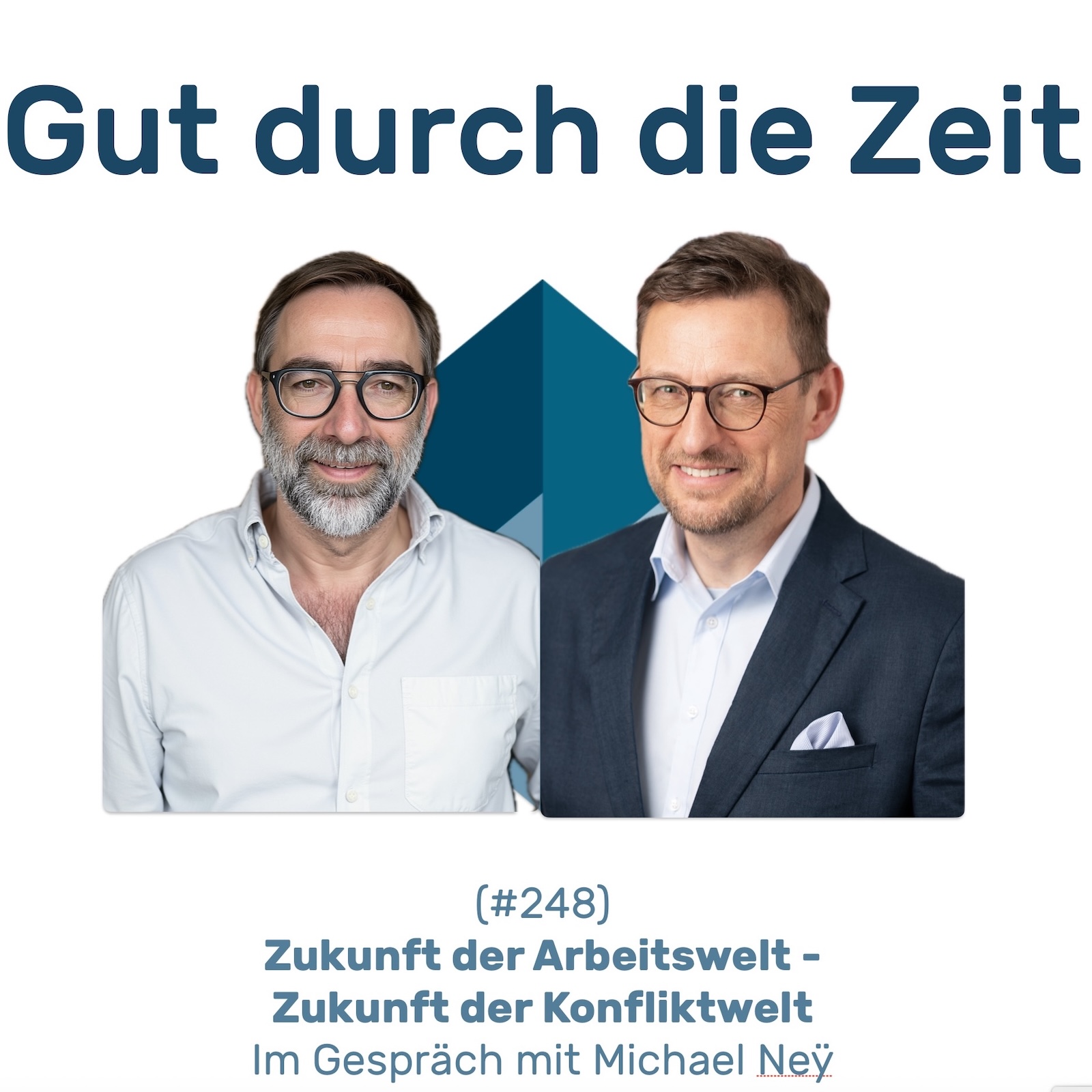
#248 GddZ

The future of the world of work - the future of the world of conflict

future skills

In conversation with Michael Neÿ

Sociologist with a focus on social psychology, systemic coach and supervisor. Since 2020 at the Research Institute for Vocational Education and Training (f-bb), since 2022 as project group leader at the Magdeburg site. Focus on "Living and working in the digitalised world" and "Psychoanalytical social psychology in organisational development". The focus is on the question of human and organisational resilience in times of change - especially from the perspective of biographical research. Since 2020, he has also been in charge of the Future Centre for Digital Work Saxony-Anhalt (ZZST), with the aim of implementing digital change in the federal state in a critically reflective manner.

Michael Neÿ is on the board of the National Guidance Forum (nfb) for the f-bb and works on the topics of professionalising guidance in education, careers and employment (BBB guidance) and the skills requirements of guidance in the digital transformation (including AI).

As a member of the Society for Psychoanalytical Social Psychology, he is also involved in the field of deep hermeneutics, with a focus on understanding latent, unconscious dimensions of social interactions, communication processes and the culture of an organisation.

Small series: Fields of mediation

Contents

Chapter:

0:04 – Introduction to the world of work
7:58 – Potential for conflict in the digital world of work
17:25 – Technology and its impact on communication
27:31 – Ambiguity tolerance in the work environment
40:04 – The role of humanity in the digital future

detailed summary

In this episode of the podcast "Gut durch die Zeit", I take up the topic of the world of work, particularly in relation to the challenges and potential for conflict that go hand in hand with advancing digitalisation. I have Michael Neÿ, an experienced consultant and employee of the Research Institute for Vocational Trainingto discuss the changes in the working environment together. We will talk about the need to promote employees' social and communication skills in order to meet the demands of an increasingly digital working environment.

Michael provides valuable insights into his work at the research institute, where the focus is on the Development of job profiles and the Training and further education lies. We shed light on which skills are essential in a rapidly changing world of work and how these manifest themselves in the context of education and professional development. This raises the question of what it means to have an education today and what skills will be in demand in the future. Michael points out that we need to be aware of how we are adapting to digital change and what practical steps we can take to not only accept digital change, but actively participate in it.

A central topic of our discussion is the Mindfulness in communicationespecially in the digital space. We discuss how misunderstandings are increasing in online communication and the role that unreflected expectations of response times play in the way we work today. The technology itself is neutral, but the expectations associated with it and how it is used can lead to conflict. We analyse how a culture of reflective use of technology can help to reduce stress and overload, and what responsibility managers have in this process.

We also discuss the social dynamics between the generations in the workplace. Michael emphasises that stereotypes between the generations are often misunderstood and that it is more important than ever to listen and focus on individual perspectives when dealing with each other. In conflict situations, it is crucial to not with preconceived ideas to act, but the right questions to promote understanding between employees.

Finally, we will discuss the key issues of our time: What does "work" mean in a world in which many activities can be performed by machines?? How do we define ourselves when our professional identity is no longer so strongly linked to work? The answers to these questions are crucial not only for individuals, but also for companies in order to remain fit for the future.

The findings from this discussion are not only relevant for professionals in the field of organisation and training, but also for anyone interested in the future of the world of work. It is an appeal to remain flexible, to actively shape change and not to lose sight of the social aspects of work.

Complete transcription

(AI-generated)


[0:04]
Introduction to the world of work
[0:00]First of all, I believe that the technology we are talking about is neutral. And the speed at which things are happening is also neutral. The problem arises from the softening of expectations that goes hand in hand with people using this technology without reflection. Welcome to the podcast Gut durch die Zeit, the podcast about mediation, conflict coaching and organisational consulting, a podcast by INKOVEMA. I'm Sascha Weigel and I'd like to welcome you to a new episode. Today's episode is about the world of work, or what we want to call the world of work tomorrow and in the near future, which nobody knows exactly what it will look like. But some people are dealing with it and they also have to deal with the conflicts and potential conflicts that may arise. And because the whole thing is quite complex and is always linked to technology and the human factor is naturally at the centre of it, or at least needs to be taken into account.
[1:04]I have invited a very competent dialogue partner who must be familiar with the subject. Welcome, Michael Neÿ. Hello, it's great to be here. And I'm particularly pleased, because this has been planned for a long time. At least we have wanted to and been able to tackle various projects together for what feels like an eternity. And now it's working out and it fits in perfectly with our skills. You are...
[1:36]Since I've known you, I've been a colleague, counsellor, coach and also used to work in youth work. Something from my studies, where I was active. And now you're dealing with the world of work and its developments. Perhaps starting from there, what are you currently doing and what is the focus of your work there to get a first impression? Well, when I deal with the world of work, the main focus is on education, further training and the development of job profiles in the broadest sense. I work at the Research Institute for Vocational Education and Training in Magdeburg. We have several projects there that deal with transition, school, training, welcoming culture as part of the Welcome Centre and, which is probably a bit of a hook today, the Future Centre for Digital Work for Saxony-Anhalt, which deals in particular with the requirements of digital change. This is all in the context of the Research Institute for Vocational Education and Training. Perhaps because not everyone knows or has heard of it, it is nationwide and there are state-organised organisations.
[2:55]Or how is your employer organised? Well, we are part of a large educational organisation of the BBW Group, the Bayerisches Bildungswerk der Wirtschaft, which includes the FBB, along with many other institutions and facilities. That is an FBB. We don't always like to talk about branches because we really do see ourselves as a single unit that has offices at different locations in Berlin, Potsdam, Chemnitz, Nuremberg and Magdeburg. That should be five now. Leipzig is missing? Well, we are in Chemnitz. That's close by. As a native of the Ore Mountains, my heart beats faster.
[3:37]As someone from Leipzig, I'm confused for a moment, but it's not a problem. Exactly, and we do a lot of projects for companies, for clients. We do a lot of evaluations. We deal with the DQR, the German Qualifications Framework. We look at what further training formats and access to further training are available in the care professions. A year ago, two of my colleagues and I carried out a feasibility study for the Federal Ministry for Family Affairs on the topic of men in care. In other words, what kind of framework conditions are needed so that more young men decide in favour of care and nursing professions. So a bit away from the money, more towards the cliché.
[4:20]And what can you resolve there? How can programmes be designed? We are actually a research institute. In this respect, the Future Centre, which focuses on consulting, is a bit larger. I would almost say it's a marginal phenomenon in terms of content, but we have four of them. The Future Centres are funded by the Federal Ministry of Labour and Social Affairs, the ESF and then again by the federal states, and we are represented in Bavaria, Baden-Württemberg, Berlin, Brandenburg and Saxony-Anhalt. But they actually exist in all federal states and are looking at it. And that coincides with the core of what we do. How is continuing education developing? How is vocational training developing in the context of digital change, of good work? In other words, how does digitalisation create good work? In other words, I could ask the research institute what is worth learning that will still be done by humans the day after tomorrow?
[5:23]And the big question for education is one that has already preoccupied us in our generation. We probably won't be working for another 40 years in a labour contract and employment relationship with what we learn at school. What is still worth learning? Programmers have just experienced this in recent years. It has always been said that if you can program IT, then everything is fine in the digitalised world.
[5:50]Salom, is that a topic that you would really get you to research and answer, so to speak? Well, we don't have that as an assignment at the moment, but yes, it's one that runs throughout. We're not working in the school sector, but in this area of education. I'm always happy to do this when I'm out and about, I once trained as a savings bank clerk on the advice of my parents. They told me that it was crisis-proof and could get me through life. I wasn't so enthusiastic about the job per se that I stayed longer than my apprenticeship. But during my apprenticeship, at the end of the 80s, account printers were introduced and a lot of the activities that we actually learnt during our apprenticeship were no longer possible. And if you look today at how many branches are being closed and there are service points, then this profession, the profession of savings bank clerk, no longer exists anyway. He then became a bank clerk, but that no longer exists. We all did a lot of online banking. You kind of have to search hard to find a branch at all.
[6:56]I think that's something that will be the future in most service professions if they don't have something to touch. Harald Lesch, I think he just said in an interview last week what he would advise physicists, young physicists, physics students, and I would actually learn a trade afterwards. So if you actually have an inclination for it, then to say, so I really want to study something or maybe it makes sense to learn a craft where I can then also mould something to my character. So it's unlikely that an AI will come and lay the pipes and clean the toilet or something like that. Although, there are already robots like that. I believe that the more creative the craft is, the more individualised the craft is, the greater the chance that it won't disappear. Did we also say that about humanities scholars? That's the most difficult question. Especially when you have a descendant who, as long as it is still possible
[7:58]
Potential for conflict in the digital world of work
[7:55]and would like to recommend and say something, to find an answer there. It's impossible to go into the question in depth, it's endlessly difficult, but the experience that professions are disappearing and new ones are emerging that we don't even have in mind has taken on a speed that also leads to our topic, namely.
[8:14]Potential for conflict in the world of work and through the world of work. It is not only a social question, but also a very individual question as to which conflicts we are currently dealing with in the world of work due to technological developments and which can also be predicted for the future. In other words, what social skills do we need in the world of work as it seems to be developing at the moment? We are currently talking about the digital space. What are the indications in this direction at the moment?
[8:51]Once again, you asked a second question about what you should learn, because I think that's also a precursor to this, because it's also about what skills I should have going into conflicts and when it comes to looking at what you should actually learn in the future, what you should concentrate on, You said yourself that you can still utilise what you learned at school, then it is foreseeable that the gap between those who will be consumers of, I'll call it consumers of AI in the future, i.e. those who have a question and ask AI, will be answered by AI.
[9:29]They know this and then accept this answer without reflection because they assume that the AI simply knows this. And the people who are reflective - and this brings us to a core competence - deal with it in a reflective way because they themselves also have knowledge, because they - there's this concept of jumping in the loop, that you also question things, that you can check the human being again at the end, is the output that comes out actually valid? So to learn, to learn and not to say, okay, I'll sit back now and my life will be comfortable, but I believe that people actually want to develop further, theoretically, or should. They should at least want to. They should want it. Exactly. I always say to my son that he's now 13 and he's going to get knowledge onto his own hard drive so that if the power and the AI fail, he'll still be able to find his way around somehow, i.e. absorb analogue knowledge. Of course, that's something I need when I get into conflicts.
[10:30]The core of the conflicts or what we are facing has a lot to do with the fact that, as you say, spaces are becoming more digital. This means that I have more to do with people in the digital space, via video calls and team chats. And of course it's quicker for misunderstandings to arise or for me to misread something that the other person didn't mean. Or someone doesn't write something in the morning. Those are just little things. And I think, why doesn't he write good morning, but just this information? So the risk of misunderstanding is greater in the digital space. So we need to be more mindful in our dealings with each other and communicate more consciously with each other and listen to how they are doing. In other words, we also need to create these spaces consciously.
[11:21]Secondly, we have technology as an additional factor when we talk about AI. This means that there may also be... Perhaps very briefly, before we come to technology. Is that a tendency that you have observed or that you recommend that the social element, the interpersonal element, is also recommended more strongly in the training occupations? That the training programmes also focus on this. Is that something that is happening or tending to become stronger?
[11:52]Or do we stick to the, shall I say, rather academic statement that we need stronger social and communicative skills in a working world that is perhaps becoming increasingly functional? In some cases, this is already included in in-company training, but not yet as a rule and not yet in the training framework plan. So there is such feedback from companies and in the management area, it is often the case that it then trickles down, it is perceived more consciously. And I think that's a necessity, but for the future, because communication is becoming more digital or there is more distance between people, when we talk about hybrid working conditions, you have to do it consciously, because this, I meet someone in the corridor or at the computer or at the coffee machine and a relationship develops because a conversation starts and I find out something about it because they tell me what they did at the weekend, that of course falls away the moment I'm working from home or somewhere mobile. It's not a bad thing that this is no longer the case, but I have to create new communicative spaces in order to have a basis, a community, so that when conflicts arise, I can resolve them together and not be faced with someone who is a complete stranger. Because that's the danger, that's another alienation, more danger of alienation in the digital space if I don't consciously create these spaces.
[13:21]That when it comes to a conflict, I'm faced with someone I don't know at all and with whom I have no positive personal or communication experience. That would be the biggest possible accident. Let's move on to the second point, the impact or effects of digital technologies, which are finding their way into every profession, every aspect of the working world, including interpersonal relationships, i.e. how we communicate, when we communicate and under what circumstances. And the everyday experience is that speed can be picked up, many things can be done more easily and, at the same time, the potential for misunderstandings, inadequate coordination and excessive demands is just as often described. You have five or six open communication channels. You write an email, you get a text message on a messenger that you may not have opened any push messages on and you don't even know which channel we're talking on. From your perspective, how do you experience this development in technology? Is it something that people find predominantly relieving because it is precisely the purpose of technology? Or does it tend to make things more difficult for people because they can no longer keep up with the changes?
[14:50]Keyword exhaustion of change. So first of all, I believe that the technology we are talking about is neutral. And the speed at which things are happening is also neutral. The problem arises from the expectations that go hand in hand with it. In other words, that people use this technology without thinking and say, okay, I've written out my email now, why didn't he reply to me within ten minutes before that time? Ten years ago, 15 years ago, that wouldn't have been an issue at all. You would have waited two days or a week. In other words, the expectation that because the technology works so quickly, people must also respond so quickly is a problem. On the one hand, because it creates conflicts in the sense of.
[15:35]Why doesn't he answer me? Does he not value me? Does he not notice me? Am I not important enough? And on the other hand, because it causes stress for the recipient who receives this message, who is supposed to reply, who is supposed to react. Because not only does this one message arrive, but there are also three construction sites and then there might be someone in the office next to me because I'm working hybrid and the phone is ringing. And of course I'm exhausted if I'm not able to take it apart and say, okay, I'm going to get up for a minute, get my coffee and then I'll sort through it. And if I'm in any doubt, I'll give you some quick feedback and say, you, it'll take 24 hours or give you a message the day after tomorrow, because I've got a full desk. But what I notice a lot, I sometimes feel the same way, it always depends on who asks or who writes me a message. I also talk a lot to colleagues who get into stressful situations like this and I try to resolve them with them.
[16:34]No, you don't have to jump all the time, but take the time you need, communicate in case of doubt, if it's something urgent, that you need time and prioritise and sort it for yourself. And don't think that just because you've received a lot of messages now, you have to deal with them all before you go home. And I don't think technology is the problem. Technology can make things a lot easier. If we handle it properly, and handling it properly means always reflecting on whether I'm letting myself be driven by the speed of technology or whether I'm saying it's nice that everything works at the same time, but I'm not working at the same time. Multitasking is a myth, we've read that a few times now somewhere in studies, it doesn't work well, so taking a step back and saying I want to do my work well and that's why I do it in order.
[17:25]
Technology and its impact on communication
[17:25]And in case of doubt, at my own pace. If I just look at my small company and my working environment, which I am still allowed to say, at least to the outside world, that I can determine myself as a self-employed person, but also see how customers and clients experience their working environment, then one phenomenon is that hardly any routines can be developed with technology, because they are already replaced by the next generation of technology before it becomes routine. And this is often a point of contention in conflict situations, although it is also clear that this is not the dispute, the conflict itself. So these communication vehicles simply lend themselves to this.
[18:13]I don't want to use media, channels and then say, you have a high duty, you have a duty to bring, I have written and the whole litany of other things. But nevertheless, it seems to me that the developments in how the other side communicates are establishing themselves so quickly that there are hardly any routines left and people simply take their own routine as the standard. I'm trying to find an example right now and the standard example is e-mail, where a large part of the generation is already saying that you might as well come by carrier pigeon, that's how old it is. What can be done in practice to coordinate the way we communicate with each other so that it is based on understanding without falling into the communication trap? We simply need to communicate more with each other. It just seems to me to be a cycle that doesn't lead to progress. It's not the quantity of communication, but the quality. These are different levels. So one thing I can actually see for myself.
[19:18]I'm currently travelling at a communication speed on too many channels. I can't manage that. So being honest with yourself, I think that's also a question of corporate culture. It's often not something that an individual can decide for themselves, but something that needs to be communicated as part of the employer's duty of care, by line managers and employees who are not afraid that something will happen to them if they communicate it. There's a lot of talk about healthy working in the digital transformation, which is also a topic we've chosen for next year at the Future Centre. That's the first thing I'm going to look at in my own environment, how I manage liabilities. There's one example where they got me, my colleagues, and we had to come to an agreement. I sometimes work at slightly unusual times. It has to do with my sleep-wake rhythm. But what I didn't realise is that when I write a message or an email to Teams at eleven o'clock on a Saturday evening, I still wonder what they're doing in my email account at eleven o'clock on a Saturday evening - not my emails, but my colleagues, because I don't write WhatsApp messages.
[20:33]That then the feeling arises that you have to respond to it or at least on Monday the feeling arises, oh God, I didn't see that. The line manager wrote, the project manager wrote, I should have responded. and to make it clear that that's the beauty of these new working models. I can combine my work with my private life, with childcare, and sometimes simply work at unusual times, independent of time and place. But I have to bear in mind that this may cause stress for others. And we made an appointment for this. We talked about it, we disclosed it. They said you're crazy.
[21:13]You can't send a message on a Sunday evening or Monday morning at four o'clock and then expect us to reply. I don't expect that at all. But I've got this message, what I wanted to write, out of my head. That means I'm not walking around with a Duracell bunny in my head all the time. I have to think about it and get rid of this task. And talking about it and taking this time again and again, for example, we organise retreats at our site once a year, once as a whole team and once in the individual projects, to see how we are doing with each other, how we communicate, what we need more of. And that ties in a little with what you said about the speed at which technology is changing, so that we keep looking at all our formats to see whether they are really still relevant. For quite some time, we had a weekly about Corona, so we had a short introduction on Monday and then continued. It continued for a while and then everyone said we didn't really want it anymore. Instead, we now have other formats, we have other meeting places, both in presence, at bouldering, at games evenings, at...
[22:21]A pop evening or something is taking place now, then we have a Study Friday. In other words, we have a day in the week that we have blocked off, where no appointments should actually come in apart from important things, where we don't schedule any appointments, because it should be there so that we can sit down, read something, meet and look at a topic together, but not be driven by anything external. Because, of course, as a research institute, we always have to look at whether I'm just working away or whether I can also find the time to get something back in. So these events to talk about how to deal with people and how to deal with them appropriately, i.e. meta-communication or a retreat, whatever you want to call it now, which have certainly been good exercises for companies for 10 or 20 years. In your observation, has this become more widespread? So more and more industry representatives have to do this because it has an impact on the world of work as a whole, not just in certain industries and professions or types of organisation, but that it is actually the tool of choice across the board to deal with the changes.
[23:39]Hey you who are listening to the podcast right now. We bring you a new episode every week in this podcast. Also for you to listen to and we need your support. Take your smartphone, leave a star rating and a comment on how you like the podcast and make others aware of this podcast here. Thank you very much and now the podcast continues.
[24:03]Yes, we haven't yet reached the point where it's actually widespread. I sometimes have the feeling or the impression that there is a bubble, which we both probably belong to, for whom it is a matter of course to do something like this, to think about it. And also to communicate this in social media, which I think creates the impression that everyone is doing it or that many people are doing it, perhaps especially in small and medium-sized companies.
[24:35]Those who have not yet somehow discovered agility for themselves, which not everyone has to do, talk about approaches to modern working. I don't think it's there yet. And technology and speed are also gradually catching up. At the same time, this is something that we at the Future Centre are also trying to bring into the companies, including our approach to work. We don't just tell you what you should do, we first look at what you actually need and what your ideas are in a participatory way. We actually just help you to find out for yourself what you need and try to convey that one of the greatest strengths for now and the future is ambiguity tolerance, i.e. the ability to tolerate uncertainty. Because that will be with us. I keep hearing people patting me on the back and saying, yes, yes, that was such a wave and now things will calm down again and then it will be good. And then I watch a lot. I find that very interesting. I wouldn't have thought that there would still be representatives of this Beetsch who seriously believe that things will calm down again.
[25:42]Yes, yes, there is still a lot of that. They often link it to robotics, so well, they can't do anything. And I just saw in yesterday's article that robots, I don't even remember what they were called, but robots with a structure similar to muscles, so not with lots of motors, but which have a completely different movement sequence, so actually human-orientated movement sequences, that's the next leap again. I never really get my head round it, because I think that a lot of things, as we've now seen with AI, are now accessible to everyone, at least the large language models. Four years ago, everyone would have said what rubbish. And that's also happening in all other things, that the time in which it becomes accessible is getting shorter. And then the next thing comes along. Yes, tolerance of ambiguity is perhaps this momentum, so to speak, or this idea that you mentioned before us in the other context of learning to learn. In other words, that we learn how to teach ourselves things. And then it's practically the annual exam, the metacommunication. What can we learn from the situation we have just experienced? Do we want to keep this up? Do we want to do something different? That this is also necessary for an organisation or a team.
[27:01]This means that a learning process is organised without someone telling us from the outside to do it this way and do it that way, but that we can think about it ourselves because we are also the addressees and experts of this problem ourselves. I think that's an important point, first of all, that, God knows, it's not yet being done across the board, across all sectors,
[27:31]
Ambiguity tolerance in the work environment
[27:26]but that it still has potential for organisations. And my thesis or a point that I bring in, because I also see this with some clients who are very agile and also very experienced.
[27:44]They would prefer to tighten up the frequency of such exams even more and consider them necessary not just once a year, but every six months. There's another aspect to this: it's simply no longer possible to cope with all the opportunities, requirements and potential fields of activity that come your way, so it seems to me that you need to be able to reduce yourself to the essentials or recognise the essentials. And that it's becoming difficult, that it's basically more and more a question of choosing from a world that is no longer manageable. So yes, I'll illustrate this with photography, that today you have to choose which five pictures you want to keep out of 3000 and that you simply don't do this because you can save them.
[28:37]But nobody looks at their entire photo library any more. And that didn't used to be a problem. You hoped you'd get five pictures from the 36 film. I think that's one of the core problems. And then we're back to the question of what you should actually learn or what you should recommend. Young people, because the problem we have, so to speak, is this.
[28:59]This is the core social problem, and I think that explains a lot of the developments that are currently taking place at various levels. Jean Hersch once wrote about the inability of people to tolerate freedom. And we have an almost infinite choice of options, for example when it comes to choosing a career. We looked earlier at how old we both are, in your time, in my time there was a manageable number of possible professions, if you... And we're not old. We're not old at all. I just want to have said it. Yes, yes, yes, yes.
[29:36]So, and there was a dial telephone. The options were totally limited. It was a manageable world. I always like to talk about my little republic in Bonn, where I lived and grew up. Today, there are so many opportunities in terms of formal education, informal training and self-determination, how can a young person coming out of school or, as adults, hardly manage to orientate themselves? And then we haven't even arrived in the virtual worlds yet. And I believe that this ability to choose, the ability to decide, what do I take now? My sociology professor always said that the most important thing you need to be able to do is know what question you're asking. If you're writing a paper, if you need something, your question. That's something that helps me today when I'm dealing with artificial intelligence, with large language models.
[30:28]Because that's exactly what they need so that I can get a reasonable result. I can't just ask anything. That's something my son sometimes despairs about when he tries to find out something via ChatGPT or something like that and doesn't get the answer he wants because he's not asking the right question. But that presupposes that I have this basic knowledge, that I know what I'm asking for. That doesn't work with my empty hard drive. That's a good point. I want to steer the conversation or the topic towards conflict. Because what we're discussing leads to. Right in the middle of it. And you are an attentive observer from the various roles that you have played in recent years and decades, even though you are not old, but you have done so in recent years and decades with the world of work. Have things essentially changed for you, so that we have to approach conflicts differently? Or are the basic structures and the basic functions and the essence of conflicts basically the same? And here we can rely on the tried and tested instruments. We could, because the conflicts, i.e. what happens psychosocially, have not changed. I believe that the problem is that social media and the ever-increasing headline mentality have caused a lot of things to change.
[31:53]People listen much less to each other and listen to what they are actually saying. So one of the conflicts that exists a lot in the world of work, which I hear again and again when we are in companies, is this supposed generational conflict with the, I don't know, they always can't tell the difference, I think Gen Z, who don't actually want to work. At least that's what was attributed to them. Exactly, it's attributed to them and you can't get it out, because it's constantly communicated in this public perception, circulated, somehow humorously picked up on, it totally manifests itself. But that means that older employees and managers also approach these younger people in the same way. They don't listen to them, but instead adopt this image and enter into this conflict according to the motto, I have an explanation pattern that has been provided to me as to why you are like this, to check their own perception.
[32:52]Because if you look at the studies, you quickly realise that no, these are people like us who are not old, but who are also no longer Gen Z, who are very enthusiastic about these new forms of work. I have colleagues at my site who were also critical at first, but who now very much appreciate these new forms of work, which are more self-determined and self-organised. But the fact that we go into conflicts with preconceived, unreflected images has, in my opinion, become much stronger. There is a very small indicator, I don't know how often, it's really inflationary, that this sentence is quoted in the social media.
[33:36]Not to listen in order to answer, but to understand. It's always popping up somewhere. And, conversely, that is a sign for me that there is obviously this perception that people are not listening. I didn't raise it in any other way, but it's an indicator for me because it's constantly being quoted. We go into a new situation, into the world of work, with stereotypes, whether stronger or not, I don't know, but we go in with very clearly perceptible stereotypes or are received in this way, so as Gen Z we tend to go in with the images of the older, more experienced generation and vice versa. And the young people at least go to social media with the expectation that, okay, I'm dealing with boomers, I'm dealing with old white men. The stereotypes are at least better known and more open. If I were to take the positive side of it, I would say that we are more aware of it, but have not yet developed a constructive way of dealing with stereotypes, because it is very time-consuming. I can rely on stereotypes and if I do, then I will see them. But dealing with the different and the strange in a way that is tolerant of ambiguity always requires a lot of special, simply energising work and attention. Perhaps one more sentence on this.
[35:01]I believe that the necessity, i.e. I get into a conflict or, in the past, I used to get into a conflict with people with whom I am in a social constellation. This means that I have to come to terms with my social environment in order to maintain my position and receive confirmation that I belong. These days, I can avoid this by diving into my digital bubble when I come home from work, even if I'm frustrated.
[35:34]I tell the story from my bubble, who all think like me, get a lot of confirmation and the next day I go back to this situation in the real world, or both worlds are real, in the analogue world and say I'm right. That's something that didn't exist in the past. I think it's really bad that I always say earlier, but that's just the way it is. It's a change that I think really has a big impact on our conflict behaviour because I no longer have to rely on the other person alone. I grew up in a village of 125 people in the Lüneburg Heath. There was no way to avoid it. There simply wasn't. And by the shooting festival at the latest, I had to get along with XY again to some extent, because we both wanted to go there and somehow do it without conflict. In this village community, we had to rely on each other. That is now the microcosm in which I grew up.
[36:27]It's the same in a company. But if I can go home and get confirmation from somewhere else and everyone says, yes, yes, that's someone from the boomer generation and that's just how they tick, you have to tell them how it's done. Maybe that really is a reliable theory, that we have more and more intensive opportunities to confirm ourselves because we have built up our bubbles in the social or digital sphere. I think it's an interesting observation that this is how we get involved.
[36:57]We have become more resistant to the immediate other and therefore, paradoxically, precisely what we have also advocated in the consulting industry, that we are empowered, so to speak, and through confirmation and support, does not materialise. On the negative side, on the negative, thoughtless side, this can also mean that we can no longer engage with each other, or at least less so. I find that an interesting point. And you can experience this as a more self-confident approach to others. So if I walk into a company where I don't go in alone, but I always have my 583 friends with me on my smartphone, who confirm to me that there are only boomers here or something like that, then that is of course a very strong position that confirms me, but at the same time also makes me unapproachable. Not very tolerant of ambiguity in modern parlance. It's like a lotus coating. A what? Lotus coating. It's like washing a car.
[38:15]Oh, that's the premium quality. Exactly, it rolls off. I don't have to deal with it. And then we also know by now that social media is not necessarily fact-based, but that it's all about emotions and whatnot. Good. Michael, I think we've reached a point where I have a spark of realisation that I didn't realise. No, not that either. I mean, that's how it goes, from young to young, from no longer growing up, but already open to ambiguity. That's exactly what you notice, so when we both go out and say we've just understood something, it's the power of this dialogue-based intelligence, of talking to each other, listening to each other and developing things further and not asking an AI and saying, give me an answer and this answer is there. I also do the maths and I don't come from the 125-person village of Wassel-Lünenburger-Heite, I come from behind the mountains in the Erzgebirge and I already do the maths, yes, we are shaped by the humanities, we are academised.
[39:22]We have now conducted this dialogue here for ourselves, we have worked our way through it. I experience in companies, even here in the region, that completely different starting worlds come into contact with each other. That's a challenge for everyone involved. And I think it's very worthwhile, also what I hear from you, that you're keeping a clever eye on the digitalisation of the world of work. This is a social event and the social element, the communicative element, is just as influential as the technology itself, or as a colleague recently put it
[40:04]
The role of humanity in the digital future
[40:00]said that digitalisation is not failing because of how we deal with technology. We have the challenge, so in this respect the human aspect, I think there is still far too little focus on it, if digitalisation and artificial intelligence continue to develop in this way, then the key question we have to ask ourselves is what do we want to be as humans? After all, we live in a society in which we are very much defined by work and the task we fulfil, what are we when AI takes care of that? What is left for us then? I think that's a question that we have to clarify for ourselves and the question arises from that. Conversely, what do we need to learn, what do we want to learn? Let's take that with us for a second episode. The understanding of work. What is work for us if someone else does it? Because until now, work has been a centre of identification for us, an identification factor.
[40:52]I recently spoke to a very experienced colleague here on the subject of our understanding of work, Professor Peter Nieschmidt, who has analysed our understanding of work in the past. And the way to God was also characterised by Protestantism. We can take the direct path through the wages on our hands.
[41:17]Our more religious Needs satisfy and that the but even not more for the The future the Labour so applies. And when the Labour as Load on the Technology delivered becomes, what makes us then still out? Today is the Labour on each Case a more authoritative Identification factor for us as People. The know we Yes from the Condition and Development from Long-term unemployment, Also the Fight at the world of work. Who may work and who must to Home remain, the one the long Time Tasty make could. You may to Home remain. But there has the Working world on each Case one whole neutral Position taken. And the is also a Topic for you probably. Who are we, when we the Labour abolished have? The dives on Edge in the Future Centre whole much on. We have it in the Care area very pronounced, because there People in the Professions gone are and also about one long Period these Professions endure, because them from Appeal there go in, because them what with People make. Then is the Fear, from the Robots or from the AI replaced to become, the is there very pronounced. Also the Working with such Technology, because the Fear is, that the Labour dehumanised becomes. So the Set, I make the Profession but, because I with the old People to do have would like, is one, the me, I have before at the Germans Red Cross in the Range Digitisation worked, there already whole much about the Path run is. And I believe, the makes it again clearly.
[42:46]That the simple also a Core topic is, the Fear of the job loss. But Why gives it these Afraid? And there goes it not only therefore, Money to earn, but the is also meaningful. What we By the way with older Men whole much see, the has itself so a little changed, but when older Men from their Profession withdraw, die them regular earlier, as Women the do. Since are we still wide from removed. May now not recalculate. No, I also not. Exactly, we approach us at best the End of the Podcasts.
[43:19]Micha, many Thanks to, also that it now to longer Time folded has, that we together a Project here, one Podcast carry out could and you Insights in the Working world and before all Things in yours Labour as Research institute supplied have. I find it Soothing to know, that it such Institutes and Contact points gives, the one question can, commission can and the itself from this Perspective with this Developments employ. The was me before even not so clear been. Yes, I am also very happy, that it the gives, because it really so one with whole many also always again new Projects Playground is, where one Questions follow up can, the actually relevant are. And the then but, we have one very narrow Transfer also then in the Company, to the clients, that from it also what is created. So that we not only for the Ivory tower before us towards research and produce, but always also in this Transfer are the Realisation and the Evaluation and then to look, like can one it again develop further. Good Success furthermore and until soon. Many Thanks to. Thank you beautiful, that I there be was allowed. The has Fun made. Very with pleasure. Bye bye.
[44:29]Michael Ney from the Research institute Operational Education. A Institute, the itself with the Working world busy, therein natural also with the Digitisation and what it required. I have me with him ventured forth, what the Working world for Potential for conflict holds ready and also still furthermore keep ready becomes. We have natural Themes struck, like sensible it is, the Learning to learn and the Further development the Organisation, of the Teams, the own Expertise in the View to take, like also recently the Keyword Ambiguity tolerance opposite the Change, opposite the Differences, the me to accommodate, one Role play becomes. And we have to the Conclusion also the Realisation hold on can, that, Solution approaches and Necessities, here on Example, like go I Strengthened in one new social Situation.
[45:36]Envelope could through new technological Developments like to the Example the social Media, the permanent Availability also from social Media. How the turn over can in, I am there so strengthened, that I already even not more me let in must on other, but very stereotypical or also so derogatory and pejorative opposite the Differences think and me so behaviour can, because I Yes sufficient Backing feel, the I me in mine Bubble get. The is also none One-sidedness, so the concerns not only one Page, but the concerns all Pages, the itself on the own Position withdraw can. The found I one interesting Point, the we in the Conversation here also marked have, therefore one very sensible Episode from mine Perspective. But like have you these Episode experienced and listened to? Leave it me and us know. Write me in the Comments or on the social Media. Leave a comment a Feedback or also one Star rating on the Podcast catchers, where you so here this Podcast belongs to have. For the Moment thank you I me with you, that you here with thereby were. I happy me, when the also at the next Paint again the Case is and remain I you with the best Wishes.
[47:00]Comes good through the Time. I am Sascha Weigel, yours Host from INKOVEMA, the Institute for Conflict and Negotiation management in Leipzig and Partner for professional Mediation procedure.