Conflict coaching / conflict counselling
for individuals and teams
Conflict management through individual counselling, conflict coaching and workshops
Conflicts are initially about (self-)reflection, not more counterproductive communication. And sometimes this is the only viable way to deal constructively with a deadlocked situation. That's why, when faced with a difficult, conflictual situation, it's worth dedicating yourself to the conflict situation through conflict coaching, a strategic retreat or another reflection format.

Who do we organise conflict coaching sessions and workshops for?
As experienced conflict and negotiation consultants, we provide support in difficult situations with professional and process expertise.
What are the benefits of conflict coaching and conflict workshops from INKOVEMA?
In conflicts, people often conclude that more communication is needed - and call for it loudly. But that's not true: first of all, less communication is needed, but (much) more reflection. What has the other person experienced or "had to" conclude that they react to me in this way, that they think of me in this way and share this with others? And just because the effects are fatal for me, the cause is not necessarily just his malice or naivety.
Conflict coaching and workshops enable precisely this emotional and mental review of one's own conflict perspective.
How can you organise conflict coaching with INKOVEMA?
In conflicts, the parties involved often put forward their own solutions. "Shut up!" - is one approach. "Do it differently!" - is one approach. "Give it back!" - is one approach. But these one-sided, uncoordinated solutions usually fail due to the de facto veto of others. Who is to blame for this is a misleading question. Our conflict counselling leads you personally back to your sphere of influence: What can you actually do to ensure that your "negotiation meeting" finally has successful consequences? The "NO!" of your counterpart does not become the explanation and end point of your blockage, but the starting point of constructive decision-making processes.
The negotiation starts with a no - and does not end.
Order clarification
In an initial meeting (approx. 60 - 90 minutes) at your premises, at our offices or via video call, we will clarify your situation and recommend possible solutions and ways of working on it. We clarify whether and under what specific conditions we are prepared to work together and achieve the goals we have discussed.
Commencement and implementation of counselling
Whether we have agreed together on an iterative coaching or counselling process or on a retreat or workshop...; the work then begins. Sometimes so-called shadow counselling is also useful. Here, the client is observed during the actual work without any mediating activities with the other stakeholders or (conflict) parties involved.
Conclusion and objectives
The counselling usually ends with a self-agreement; the client agrees on further concrete plans for change with the counsellor present as a witness.
Comments on our work
We engaged Dr Sascha Weigel to work through protracted conflicts within a software development team in order to improve the communication culture and support the strategic and personnel reorganisation of the team. We found Dr Sascha Weigel to be a careful and committed moderator and mediator who provided us with excellent support in understanding and resolving our problems, as well as helping us to focus on future directions for us as an entrepreneurial team.
 Marc Alexander Schweitzer, Deputy Director of the Institute, Fraunhofer SCAI, Bonn
Sascha has conducted extensive mediations in our company. Our company is characterised by diversity - with all its light and dark sides. We could always rely on him in difficult phases, ... a helpful mixture of scientific depth and practical relevance, extremely approachable and with great composure ... but my favourite thing about him is his humour!
 IDA SCHÖNHERR, Formerly BASF Berlin, Chairwoman of the Works Council
As BASF Services Europe GmbH, we asked Dr Sascha Weigel (INKOVEMA) to mediate a conflict in one of our departments in 2015/2016. With outstanding professionalism, he grasped the problem of the conflict situation and also considered the organisational implications in a diverse working environment.Dr Sascha Weigel enabled us to deal with the relevant issues appropriately and make sensible decisions by providing prudent advice to the management level, including the works council, as well as through dedicated mediation and workshops together with the parties involved.
 Rita Lampasona-Hornung, BASF Services Europe GmbH, Berlin, Head of Department, client since 2017
Valuable was the structural help of your approach and the completely different perspective...such as ...much of what we call conflicts are actually attempts to resolve them....
 Katinka Schulz, fgi-FischerGroupInternational
We are impressed by the way Dr Weigel adapts to the particularities of different university structures and offers very appropriate support without intervening himself. He professionally supports those involved in finding their own solutions.
 DR. KATHRIN CARL, Head of Human Resources Development and Training, FSU Jena, client since 2017
A SELECTION OF OUR CUSTOMERS


Blog posts on mediation
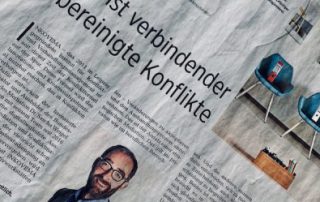
Interview: Few things are more unifying than resolved conflicts
Few things are more unifying than resolved conflicts ...or why conflict management is not about removing obstacles, but about innovation and creativity. (Unabridged) Interview, LVZ 27 July 2019 Dr Weigel, what exactly is a conflict? The [...]
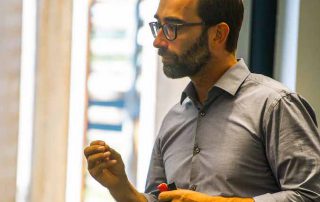
Mediation in organisations – An interview on the innovation-promoting work of mediators in and for organisations.
Mediation in organisations. An interview on the work of mediators in and for organisations with Dr Sascha Weigel. The interview - abridged here - was conducted by Sarah Lipot in December 2018. Sarah Lipot is currently studying [...]