

INKOVEMA Podcast „Well through time“
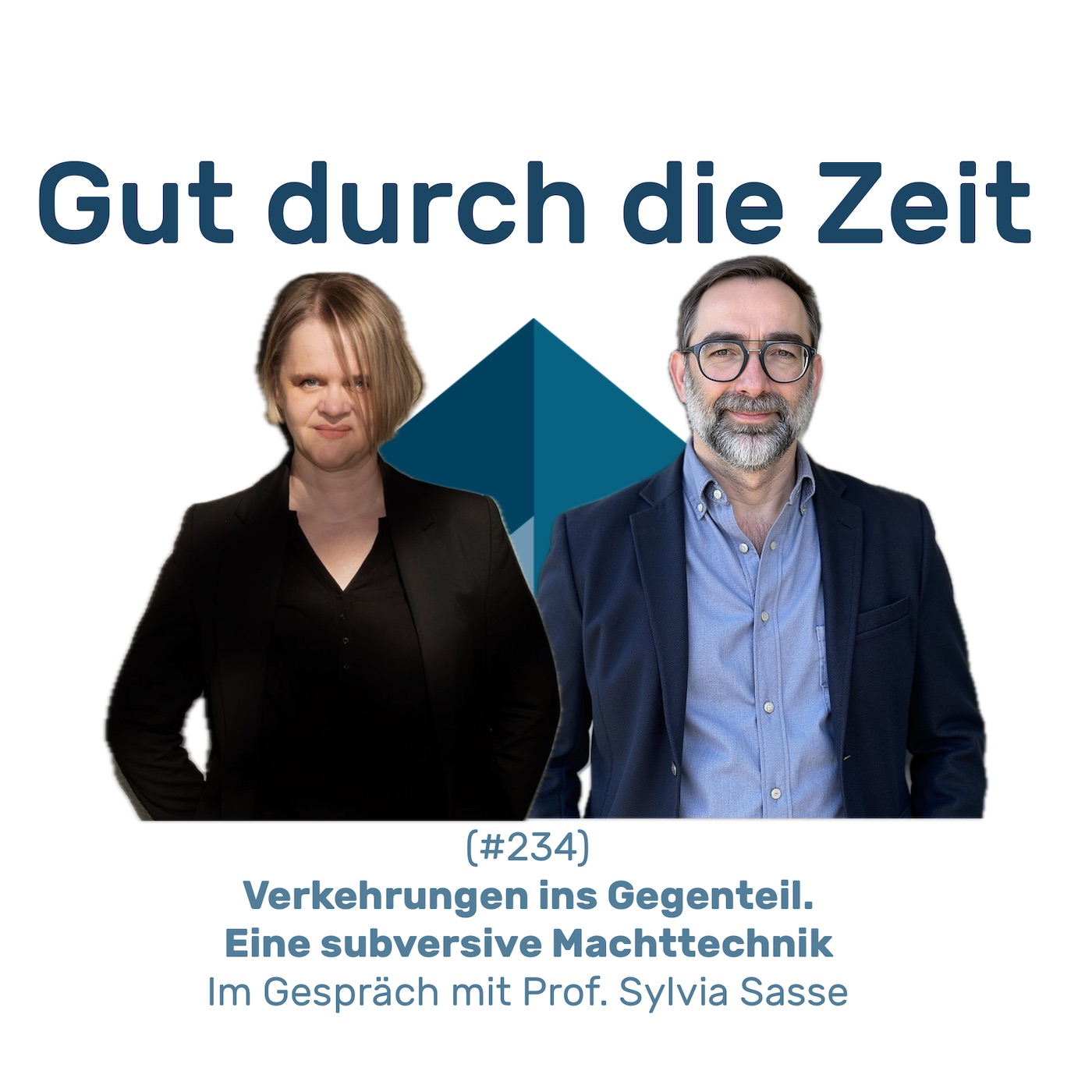
#234 GddZ
Reversals into the opposite
A subversive power technique
In conversation with Prof Sylvia Sasse
Sasse teaches Slavic literary studies at the University of Zurich. Born in Magdeburg in 1968, she is a co-founder and member of the Centre for Arts and Cultural Theory (ZKK) and editor of the online magazine "Geschichte der Gegenwart". In her research, she focuses intensively on political language and political speech acts, e.g. in the Stalinist Soviet Union. Since 2022, she has headed the research project "Art and Disinformation", which is funded by the Swiss National Science Foundation.
In 2023, Matthes und Seitz published her essay "Verkehrungen ins Gegenteil. On subversion as a power technique".
Small series:
Contributions from Socio-political conflict situations - as a result of the return of war on European soil and in European politics
Contents
Chapter
0:05 Introduction to reversals to the opposite
24:54 The influence of propaganda and the media
35:07 Subversion in politics and power structures
44:35 Traffic in everyday life and conflicts
50:30 Summary and outlook for the future
Summary of content
In this episode, I look at a fascinating and complex phenomenon that occurs not only in the political arena, but also in everyday conflicts: the so-called inversions into the opposite. These powerful rhetorical techniques are far more than simple projections. You leave behind a subversive influence, appropriate the (often positively connoted) termsso that the way, how we conduct discourse has fundamentally changed. To explore this topic, I invite the expert Professor Silvia Sasse, whose research helps us to better understand these techniques in different contexts, from politics to personal disputes.
Professor Sasse brings her insights into political strategies, particularly in the context of the conflicts in Eastern Europe and the rhetoric of leaders such as Vladimir Putin. She emphasises that such reversals are often used as a defence mechanism when justifying aggression in response to real or fictitious threats. A key example used to illustrate this is the Russian invasion of Ukraine, where narratives of defence and deconstruction of reality profoundly influence perceptions.
Our discussion also takes on psychological dimensions by looking at the mechanisms by which the feelings of victim and perpetrator are reversed. Professor Sasse describes how, in public perception, mistakes and aggression are often projected onto others, while one's own actions are strongly optimised and staged as positive. These techniques are not only found in geopolitical conflicts, but also in everyday life, for example in companies and social relationships. Here we explain how criticism is misinterpreted as approval and how the dynamics of power and control work on an intrapersonal level.
Finally, we reflect on the relevance of reversals in the context of mediation work. The attempt to resolve conflicts through neutrality and equivalence is considered challenging, as often not only interpretations but also the underlying power structures and motivations of the conflict parties are influenced.
In summary, this episode offers an analysis of the subversive power technique of reversal into the opposite and encourages us to explore the underlying narratives in conflicts in order to recognise and address misunderstandings and injustices.
Complete transcription
Kommentieren
Weitere Beiträge

25 Beiträge zu den Grundlagen der Mediation
Hier finden Sie alle 25 Beiträge zu den Grundlagen der Mediation, die hier veröffentlicht wurden.
Weitergehende Vertiefungen bieten unsere Ausbildungen sowie unsere lernunterstützende Webseite www.elemente-der-mediation.de